
Maybe it happened at a parent evening, or in a quick chat after a school meeting. Someone, a teacher or another parent, said the words: “You should apply for concessions.” You nodded, then spent the drive home wondering: what exactly are IEB concessions? What types are there? And would my child even qualify?
If your child is at an IEB school and lives with a barrier to learning like dyslexia, ADHD, anxiety, slow processing speed, or a physical or medical condition, this guide is for you. The IEB (Independent Examinations Board, the exam board used by most independent schools in South Africa) has a formal system of exam accommodations and concessions. The official policy reads like, well, a policy. Here is what it actually says, in plain language.
What “accommodations” and “concessions” actually mean
The IEB’s updated Policy and Procedures: Accommodations and Concessions took effect in June 2025. One helpful change: “exemptions” are now called “concessions”, so if an older report or teacher says “exemption”, they mean the same thing.
The two words matter:
- An accommodation changes how your child writes the exam: extra time, a reader, a scribe, a separate venue. The exam itself stays the same.
- A concession changes what your child must offer: for example, taking only one official language instead of two.
The principle is fairness: support that lets a candidate with a barrier to learning show their true ability, without changing what the exam measures or giving an advantage over others.
One thing that surprises parents: the decision lies with the IEB’s Accommodations/Concessions Panel, not the school, not the assessing psychologist. A diagnosis alone is never a guarantee.
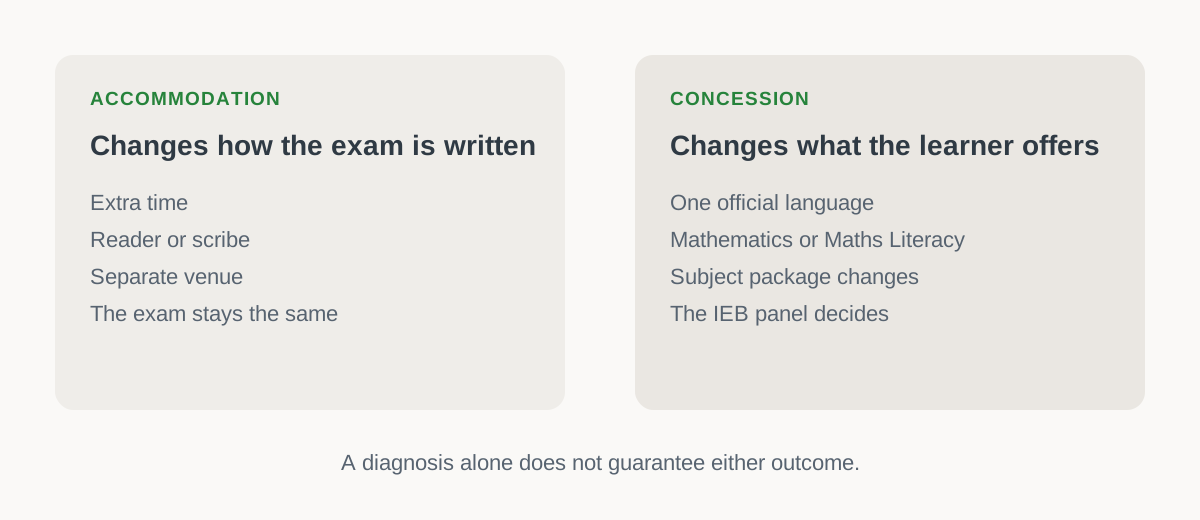
An accommodation changes how the exam is written. A concession changes the subject package or requirement.
What types of exam accommodations does the IEB offer?
What is actually available? Here is the full list.
Time and pacing
- Additional time: the best-known option: 5 to 15 minutes per hour depending on severity, up to 30 minutes per hour for severe visual or hearing impairment. Granted time applies across all subjects.
- Rest breaks: up to 10 minutes per hour away from the desk (but inside the venue), to manage pain, anxiety or blood sugar. Separate from additional time, with medical motivation required.
Reading support
- Reader: a human reader, electronic reader, or exam reader pen that reads the paper aloud (separate venue and audio recording for a human reader).
- Rephrased exam papers: the language of the paper is simplified, for candidates who are deaf or hearing impaired.
- Adapted papers, braille papers and word processors, and enlarged-font papers (size 18) for visual barriers.
Writing support
- Scribe or voice-to-text software: the candidate dictates; the scribe records their words verbatim, in a separate, recorded venue. Not available for papers with a practical component.
- Computer: typed answers, with spellcheck, grammar check, internet and all stored material disabled.
- Handwriting accommodation: a sticker on the answer book asks the marker to accommodate hard-to-read writing.
- Spelling accommodation: the marker ignores spelling errors provided the word can still be deciphered phonetically, except in language papers where spelling itself is being examined.
Focus, health and environment
- Prompter: an adult who refocuses an easily distracted candidate with a simple agreed cue: a phrase like “focus on your work”, or a tap on the desk.
- Separate or smaller venue: for candidates whose medical, psychological or learning barriers make the main exam hall unmanageable.
- Medication/food intake: permission to take medication, or snacks and drinks to manage blood sugar, during the exam, with medical motivation.
- Practical assistant and specific equipment, considered case by case.
Oral assessments
- Exemption from oral activities and assessments: for candidates with communication disorders such as severe stuttering or non-verbal autism, oral components can be replaced with alternate-format tasks.
What types of IEB concessions are there?
Concessions change your child’s subject package. They apply only to the FET phase (Grades 10–12). The standard timing is to apply by the end of July of the Grade 9 year, so the concession is in place from the start of the FET phase, but it is not limited to Grade 9. A concession can also be applied for in other grade years if the barrier is only identified later:
- Language concession: the candidate offers only one official language (at First Additional Language level at minimum), with another subject taken in its place. It is intended for severe, intrinsic language-related barriers such as deafness, dysphasia, or neurological and developmental disorders like severe dyslexia or autism spectrum disorder.
- Mathematics/Mathematical Literacy concession: exemption from offering Mathematics or Mathematical Literacy. It is intended for severe, intrinsic barriers in mathematics, such as dyscalculia.
- Endorsed NSC: for a candidate who cannot meet the full NSC requirements: five subjects passed at 30%. One caveat: an endorsed NSC may limit access to higher education, so research study options carefully first.
How does the IEB application process work?
This part catches families off guard: you don’t apply to the IEB directly. The school applies on your child’s behalf, submits all documents electronically, and handles queries about the outcome.
The application lives and dies on evidence: a full psychoeducational assessment (cognitive and educational testing by a registered psychologist or psychometrist, the educational part no older than a year), comments from at least three subject teachers, recent school reports, samples of your child’s work, and a medical report where the barrier is medical.
Processing takes about 12 weeks, so the deadlines matter:
- Accommodations, Grades 8–11: 31 October
- New Grade 12 applications: 31 March, with an additional priority levy
- Concessions: standard timing is the end of July in the Grade 9 year; a concession can also be applied for in later grades
And one honest caveat: informal extra time from the school is no guarantee the IEB will grant it. The formal application is what counts.
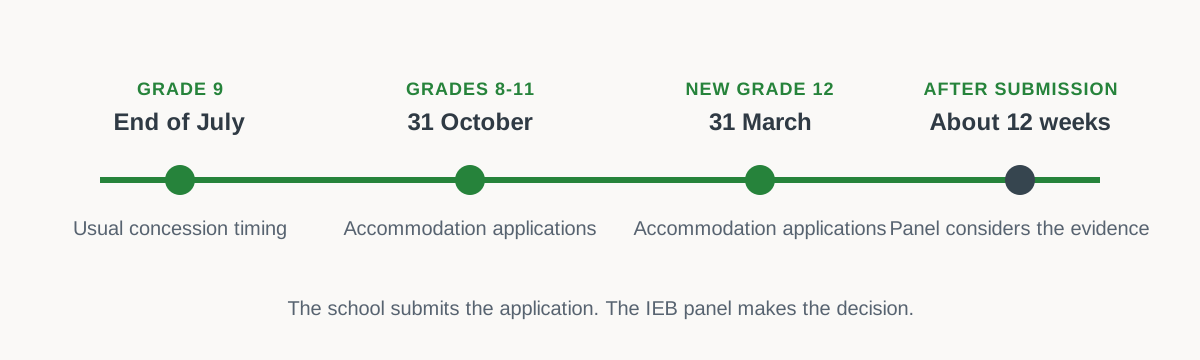
Start early. The school submits the application, and the IEB panel considers the evidence.
As a registered Educational Psychologist (HPCSA Reg. No: PS 0158127), the assessment side of this process is exactly the work I do. It is the gateway: without it, the IEB won’t process the application; with it, the panel has the evidence for a fair decision.
Practical takeaways for parents
- Start earlier than feels necessary. For most families Grade 9 is decision season for concessions, but a concession can also be applied for in a later grade if needed. Still, the earlier the better, since 31 October comes quickly with 12-week processing.
- Keep a paper trail. School reports, teacher comments and unfinished timed tests show the difficulty in real exam conditions.
- Don’t assume informal school support carries over. Only a formal IEB application secures it for the NSC exams.
- Work with the school, not around it. They submit the application. Bring them onside early.
- Unsure whether your child would qualify? Start with a conversation rather than waiting for matric to force the question.
Frequently Asked Questions
What is the difference between an IEB accommodation and a concession?
An accommodation changes how your child writes the exam: extra time, a reader, a scribe, a separate venue. A concession changes what your child must offer, such as taking only one official language or being exempted from Mathematics. Both are decided by the IEB’s Accommodations/Concessions Panel.
Does my child need a psychoeducational assessment to apply for IEB concessions?
Yes, a full psychoeducational assessment is the core evidence in almost every application. It must be done by a registered psychologist or psychometrist, and the school submits it together with teacher comments, school reports and work samples.
When should we apply for IEB accommodations or concessions?
IEB accommodation applications for Grades 8–11 close on 31 October, and new Grade 12 applications close on 31 March with an additional levy. For concessions, the standard timing is the end of July in the Grade 9 year, so the concession is in place when the FET phase begins in Grade 10, but that is not the only window. A concession can also be applied for in a later grade if the barrier emerges or is only identified then. Processing takes about 12 weeks.
Our school already gives my child extra time: is that enough?
Unfortunately not. The IEB is explicit that internal accommodations granted by a school are no guarantee that the IEB will award the same accommodation. A formal application through the school is what counts.
If this sounds familiar
If you’re weighing up whether your child might qualify, a psychoeducational assessment is the required first step, and shows exactly where the difficulty lies. You may also find it helpful to read the 5 signs your child may need a psychoeducational assessment. And if exam season is overwhelming at home, exam stress management support can work alongside any accommodations.
You don’t have to decode policy documents alone. If you’d like to talk through your child’s situation, get in touch.