“Have you thought about a remedial school?” A teacher may mean it as a practical suggestion. For a parent, it can bring a rush of questions. Would a smaller class help? Is an LSEN school the same thing? Are we considering a move too soon?
Before you choose a school, start with two questions: what support does my child need, and which setting can provide it consistently? I am a registered Educational Psychologist (HPCSA Reg. No: PS 0158127) practising in Centurion and Middelburg. My role is to clarify learning needs and translate findings into practical support, so the school discussion is based on what your child needs.
The short answer: a mainstream (ordinary) school is where most South African learners are taught, and support for a learning barrier should start there. “Remedial school” is an everyday name for a school, often private, that offers focused learning support. In the public system, a move to a full-service or special school is decided through the SIAS process, and only when a learner’s support needs cannot be met where they are.
What is the difference between mainstream, full-service, special and remedial schools?
In the public-school system, South Africa’s Department of Basic Education describes three broad settings [2].
An ordinary or mainstream school is where most learners receive their education. Support should begin there when a barrier to learning is first noticed.
A full-service or inclusive school is an ordinary school strengthened to support a wider range of needs. It may have additional training, resources and links to district support, although what is available differs from one school to another.
A special school, or special school resource centre, offers intensive support for learners who need high levels of support. Class sizes and on-site resources vary from school to school, so ask about them directly rather than assuming. Some also run outreach to nearby ordinary schools.
The language parents hear does not always match the policy. Remedial school usually refers to a school offering focused learning support. LSEN means Learners with Special Education Needs, a term that still appears in some school names. Current SIAS policy uses ordinary, full-service and special school categories instead.
Public-school placement follows the SIAS process described below. A private remedial school’s application process may be different, so ask whether the school is public or private, what admission evidence it needs, and exactly what support it provides.
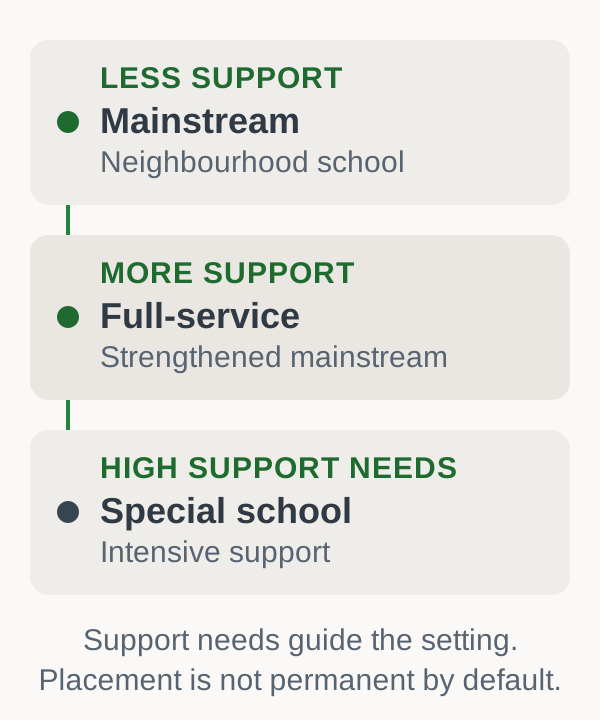
The setting should follow your child’s support needs, and it is reviewed over time.
How does the SIAS process decide what support my child gets?
SIAS stands for Screening, Identification, Assessment and Support. Approved on 19 December 2014, it sets the public-school process for identifying a barrier to learning and deciding what support should follow [1][2]. It is not a test that your child passes or fails. The focus is the level of support a learner needs, not a label alone.
Parents are part of that process. The policy calls parents and caregivers equal partners whose participation is required, and from age 12 the learner is included too, as far as possible [2].
The process moves through three stages. In the classroom, the teacher records the concern on the Learner Profile, completes SNA 1 and begins support. At school level, the School-Based Support Team reviews the case through SNA 2 and develops or updates an Individual Support Plan [2]. The record shows what has been tried, for how long, and what changed.
If the school needs district help, the case moves to the District-Based Support Team. Using SNA 3, the team considers whether the support required is low, moderate or high. It looks at how often support is needed, how extensive it is, what resources are available and what it will cost [2]. The district team then plans the next steps with the school.
A different placement is considered when the learner’s needs cannot be met through the support available in an ordinary or full-service school. The policy says specialised placement is a last resort and should not automatically be permanent. The team should continue considering whether the learner can return to an ordinary school [2].
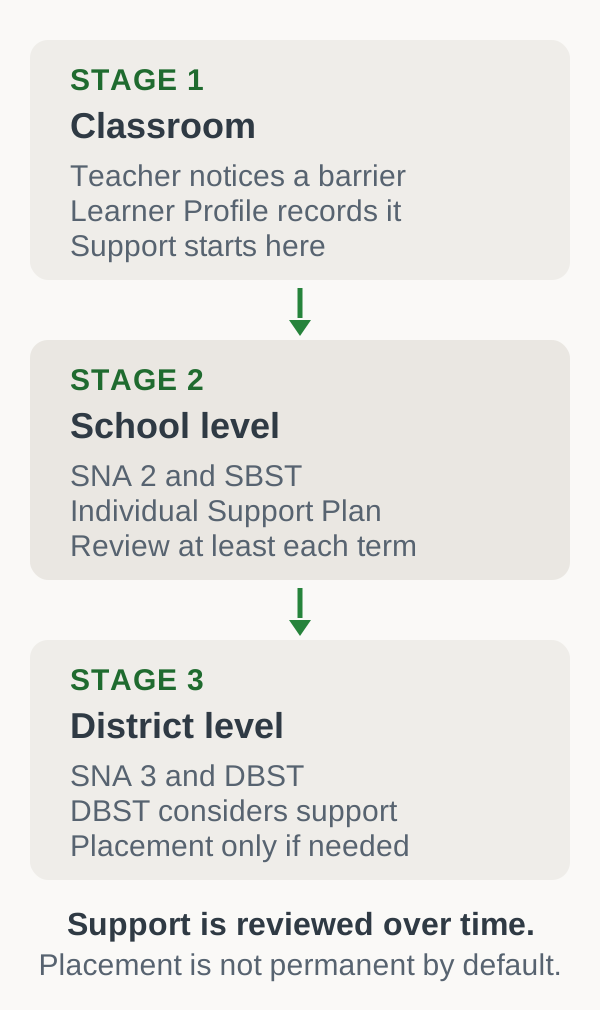
SIAS starts in the classroom and moves to school and district support before another placement is considered.
Does my child need an assessment to change schools?
Not automatically. The policy treats standardised and psychometric tests as only part of the evidence, used when appropriate [2]. An assessment is one input among several, alongside teacher observations, work samples and the record of support already tried.
When the team needs a clearer picture of the barrier, a psychoeducational assessment can describe your child’s learning strengths and difficulties and help connect recommendations to the classroom. A useful report shows how the findings should change support at school.
If reading is your main concern, our guide to how to test your child for dyslexia in South Africa explains what that assessment involves.
What does South African research say about inclusive education?
Donohue and Bornman (2014) examined why South Africa’s inclusive-education policy had been difficult to put into practice. They reviewed the path from White Paper 6 to what schools could provide. This was a policy analysis, not a study comparing outcomes in mainstream and special schools [3].
The article was published before SIAS came into effect, so it cannot tell us what support is available in a particular district today. Schools can differ in staff, resources and specialist access even when the policy describes the same route [3].
You can ask your school, the School-Based Support Team or the district office what full-service and special-school support is available in your area and how referrals are handled. Ask: “What level of support does my child need, and where nearby can that support be provided?”
Rule out the physical first
Learning difficulties can look a lot like vision, hearing or other health problems. If your child complains of headaches, has stomachaches before school, or struggles to see or hear instructions, ask your GP or paediatrician where to start. An optometrist or audiologist may also need to check a specific concern. If the difficulty is persistent or affects daily life beyond school, rule out physical causes before treating a school move as the answer.
What to do before you decide
Collect the paper trail. Gather report cards, work samples, teacher notes and any Individual Support Plan. If no plan exists, ask the teacher or School-Based Support Team what support can begin now.
Ask where you are in the SIAS process. Find out who is coordinating the case, what has already been tried and when the plan will be reviewed.
Be clear about what an assessment must answer. Ask how it would change the support plan or placement decision. If classroom adjustments have not been tried, those can begin while the need for assessment is considered.
Visit schools with support in mind. Ask about class size, language of instruction, curriculum, specialist access, transport and how placement is reviewed. A familiar label is less useful than a clear account of what your child would receive each day.
Frequently Asked Questions
What is the difference between a remedial school and an LSEN school in South Africa?
Remedial school and LSEN school are everyday terms that overlap, but they are not interchangeable official categories. Current DBE policy describes ordinary, full-service or inclusive, and special schools. Because these are older or commonly used terms, ask each school what support it provides and whether it is public or private.
Does my child need a psychoeducational assessment to change schools?
A psychoeducational assessment is not automatically required to change schools. The SIAS policy treats standardised and psychometric tests as only part of the evidence, to be used when appropriate. An assessment may help when the existing school information does not explain the barrier clearly or when the team needs guidance on suitable support.
Is moving to a remedial or LSEN school permanent?
Moving to a remedial, LSEN or special school is not meant to be automatically permanent. Under the public-school SIAS process, placement in a specialised setting is a last resort. The team should keep considering whether the learner’s needs can be met in an ordinary or full-service school.
What is a full-service school?
A full-service school is an ordinary school strengthened to support a wider range of learning needs. It may have additional training, resources and links to district support, but the help available still varies by school. Ask what support is currently in place for your child’s particular needs.
A gentle next step
If you are weighing a school move, base the decision on what the school has tried, what your child still needs and what each possible setting can offer. If you would like help deciding whether an assessment could add useful information, you are welcome to send me a message, whether you are in Centurion, Middelburg or somewhere in between.