Your child’s teacher may suggest an occupational therapist or educational psychologist, while your GP mentions a psychiatrist. You leave with three names and no clear idea who to call first.
Start with the concern, not the job title. Each profession asks a different question about your child. Once that question is clear, the first call is usually easier to choose.
What does an occupational therapist look at?
In occupational therapy, an “occupation” is an everyday activity. For a child, that includes dressing, eating, writing, playing and taking part in class.
The Occupational Therapy Association of South Africa uses the World Federation of Occupational Therapists’ definition: the profession supports participation in meaningful everyday activities [1]. An HPCSA article on early-childhood care describes occupational therapists looking at fine-motor skills, posture and coordination, sensory responses, self-care, play and social participation [2].
OT may be a useful first step when the main concern sounds like this:
- handwriting is tiring, slow or difficult to read
- buttons, shoelaces, cutlery or other daily tasks are unusually hard
- noise, clothing textures or busy classrooms regularly overwhelm your child
- balance, coordination or motor planning gets in the way of play or classwork
These signs do not prove that your child needs OT. They simply help you describe the problem when you make that first call.
What does an Educational Psychologist look at?
An Educational Psychologist looks at learning and development, including the emotional and social factors that affect them. The HPCSA Professional Board’s 2017 practice guidelines include assessment of cognitive abilities, scholastic progress and emotional functioning, as well as support for children, parents and schools [3].
I am registered as an Educational Psychologist (HPCSA Reg. No: PS 0158127). In my work, the starting question is often why school has become harder than expected. A psychoeducational assessment can bring together parent and teacher input, observation and standardised assessment to understand a child’s pattern of strengths and difficulties. For a child not yet in formal schooling, a school-readiness assessment looks at the skills that support the move into Grade 1.
An Educational Psychologist may be a sensible first call when:
- reading, spelling, maths or written work is not progressing as expected
- attention or anxiety seems to be affecting learning
- there is a large gap between what your child understands and what appears on paper
- school worries, behaviour or big feelings are getting in the way of development
Educational Psychologists can also offer psychological support within learning and development. When a concern falls outside that scope, referral is part of responsible practice [3].
What does a psychiatrist look at?
A psychiatrist first qualifies and registers as a medical doctor, then completes specialist registrar training in psychiatry [4].
Psychiatrists assess mental-health conditions from a medical perspective. As medical practitioners, they can consider physical health and diagnose [4], and prescribe medication where indicated [5]. Your child may need this kind of assessment when concerns are severe or persistent, affect several parts of daily life, or raise a medical question.
If you are unsure, a GP or paediatrician can be a practical starting point. You do not have to decide on a diagnosis before asking for help.
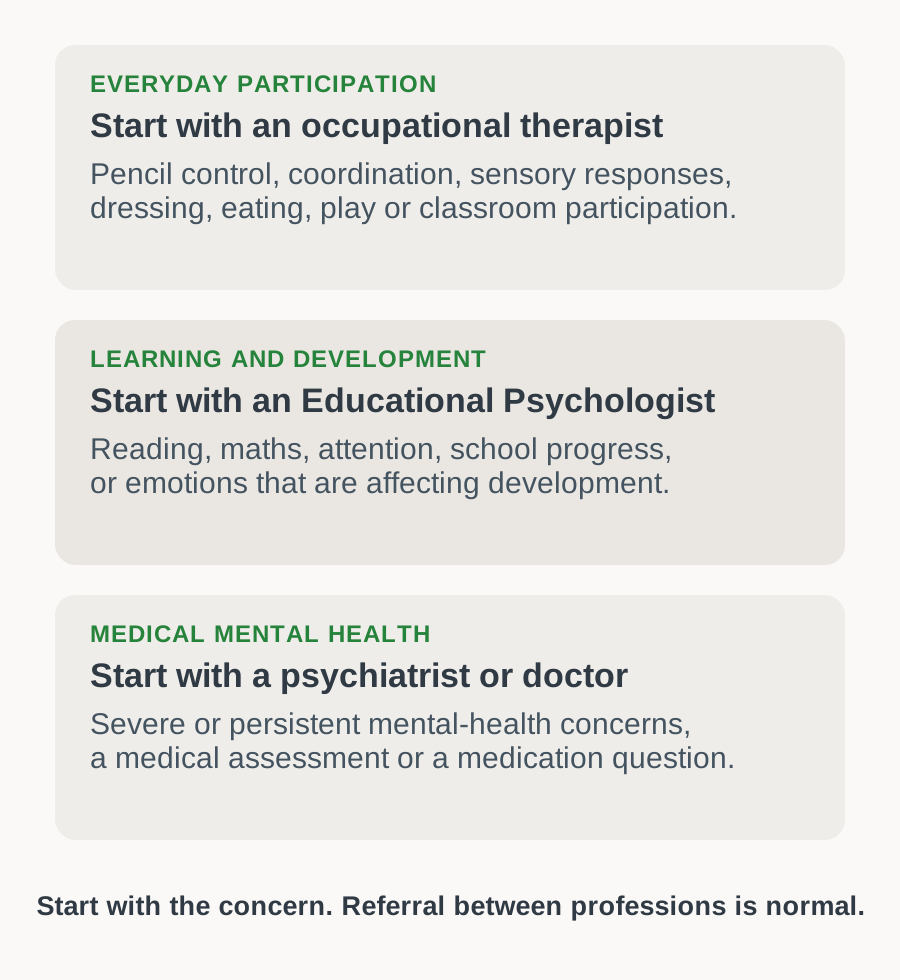
Choose a starting point from the concern you can see. Referral between professions is a normal part of care.
What if the signs overlap?
They often do. A child who avoids writing may have a fine-motor difficulty, a learning difficulty, anxiety about making mistakes, or more than one of these. One symptom cannot tell you which explanation is right.
A 2023 systematic review examined 18 papers on occupational therapy support for primary-school children with additional needs [6]. The authors found support for school-based OT and interdisciplinary work, but they also warned that the studies varied widely, were generally of limited quality and often had small samples. None was South African, so the review supports teamwork as a sensible approach, not a promise about a particular child.
The HPCSA Professional Board’s guidance makes the local expectation clearer: psychology categories should collaborate and complement one another, with referral when another professional’s input is needed [3]. Each scope gives a family another way to understand the same concern, without placing one profession above another.
Rule out the physical first
Headaches, stomachaches, poor sleep, hearing problems or difficulty seeing the board can look like attention, learning or emotional difficulties. A GP or paediatrician can check physical causes first and refer for vision or hearing testing where needed.
Seek prompt professional help if your child’s distress is severe, persistent or affecting life beyond school. You can begin with your GP, paediatrician or an appropriate mental-health professional.
How to choose your first call
- Write down what you see: use examples such as “writing hurts after five minutes” or “reading homework ends in tears” instead of trying to name a condition.
- Ask what the professional will assess: a short phone conversation should clarify whether your question fits their scope.
- Bring the same information to each appointment: school reports, teacher feedback, previous assessments and a list of your concerns reduce repetition if a referral follows.
- Check HPCSA registration: ask for the person’s registered profession and registration number, then verify it through the HPCSA’s online register [7].
The first appointment does not lock your family into one route. A careful professional will explain what they can help with and where another perspective is needed.
Frequently Asked Questions
Should my child see an occupational therapist or an educational psychologist?
Start with the concern you want help understanding. Fine-motor, sensory and everyday participation difficulties often point to an occupational therapist, while learning, school progress and emotions linked to development often point to an educational psychologist.
When should a child see a psychiatrist?
A psychiatrist may be the right starting point when there are severe or persistent mental-health concerns, a need for medical assessment, or a question about medication. Your GP, paediatrician or psychologist can also help you decide whether a psychiatric referral is needed.
Can an educational psychologist prescribe medication in South Africa?
No. An Educational Psychologist is not a medical doctor and does not prescribe medication. A GP, paediatrician or psychiatrist can assess medical questions and discuss medication when it is relevant.
Can my child need more than one of these professionals?
Yes. A child may need different kinds of support at the same time or at different stages. With your consent, professionals can share relevant findings and keep their work within their own areas of training.
Where I can help
If your concern is about learning, school progress or emotions linked to development, a psychoeducational assessment may help clarify the next step. For a younger child who needs space to work through feelings or difficult experiences, play therapy may be more suitable.
You can also read the signs that may point to a psychoeducational assessment or send me a message with what you are noticing. There is no obligation to book. If another profession fits your concern better, I will tell you.