The Grade 9 subject choice form can make an ordinary evening feel unusually serious. Your child may still change their mind about careers from one week to the next, yet the school is asking for subjects they will take from Grade 10 to matric.
That does not mean a fourteen- or fifteen-year-old must choose a lifelong career now. A good Grade 9 subject choice keeps sensible options open and gives your child a subject package they can manage with interest and effort.
As a registered Educational Psychologist (HPCSA Reg. No: PS 0158127), I help families in Centurion and Middelburg work through this decision without treating one form as a verdict on a child’s future.
What your child is choosing in Grade 9
The Department of Basic Education (DBE) explains that a learner working towards the National Senior Certificate takes at least seven subjects in Grades 10 to 12 [1]. Four subject areas are compulsory:
- Home Language
- First Additional Language
- Mathematics or Mathematical Literacy
- Life Orientation
Your child then chooses three electives from the subjects offered by their school. The DBE lists 25 approved optional subjects, but no school is expected to offer all of them [1]. Start with the school’s own subject form, not a list shared by another school or found online.
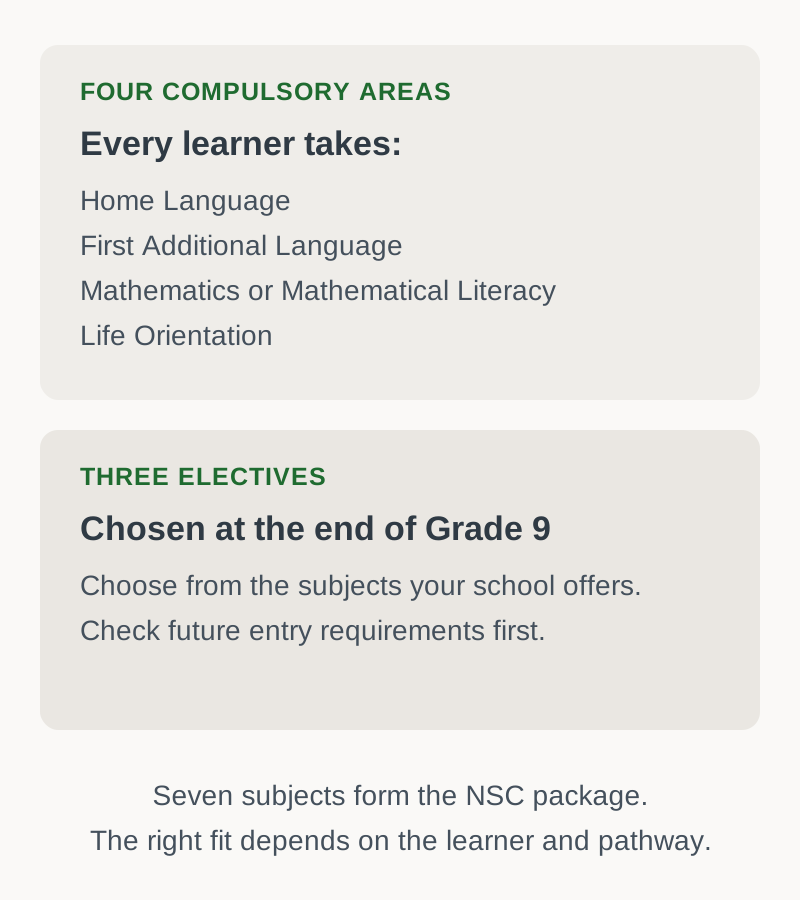
The NSC subject package combines four compulsory areas with three electives offered by the school.
The choice matters because some courses after matric require specific subjects and marks. It is still only one part of admission. Universities and colleges set their own programme requirements, and these can change, so check the current prospectus for each institution rather than relying on an old APS table or another family’s experience.
Mathematics or Mathematical Literacy
This is often the hardest part of the form.
Mathematics is required for many degrees with substantial mathematical content, including engineering and several science programmes. Mathematical Literacy focuses on using mathematics in everyday contexts and is accepted for many other programmes. Neither subject is automatically the better choice for every learner.
Look at three pieces of information together: your child’s current Maths results, the teacher’s view of whether the Grade 10 Mathematics workload is realistic, and the latest requirements for two or three study areas your child might consider. A learner who takes Mathematics must still meet the required mark. Choosing it simply to “keep every door open” can backfire if the subject becomes a constant struggle.
Moving from Mathematics to Mathematical Literacy later is usually easier than moving in the other direction because changing back requires missed content to be caught up. School timetables and internal rules also affect what is possible. Ask the school how it handles changes before you sign the form.
Subject changes are possible, within limits
National policy allows a learner to change up to two subjects in Grade 10, provided the change is made by the start of the third term. Up to two changes may be made in Grade 11 before 28 February [2].
In Grade 12, one subject change may be approved only in exceptional cases, before 31 January. The request needs the assessment body’s approval as well as written motivation and support from the school [2]. This makes Grade 9 important, but not irreversible.
There is also a different route after Grade 9: the National Certificate (Vocational), or NC(V), at a TVET college. It is not an alternative version of the NSC. It is a separate curriculum, and the Department of Higher Education and Training warns that moving between the two routes may mean repeating grades or subjects [3]. Families considering NC(V) should speak directly to the relevant college before deciding.
How career guidance can help
Marks are useful, but they only show part of the picture. A child may earn similar marks in two subjects while finding one satisfying and the other exhausting. Another learner may have a strong interest in a field without yet knowing which school subjects support it.
CAPS Life Orientation prepares learners for this discussion through its World of Work content. In Grades 7 to 9, learners consider their interests and abilities, the practical and theoretical demands of subjects, and the relationship between subject choices and possible careers [4]. Those class activities are a good place to begin.
A career guidance assessment can add structured information about aptitude and interests, considered alongside school reports and the routes your child is exploring. The HPCSA’s practice guidelines include career assessment and counselling within educational psychology [5]. The result is not a computer-generated career answer. It is a conversation about patterns, options and trade-offs, followed by decisions made by the learner and family.
If school results are unexpectedly uneven or learning has been difficult for some time, a psychoeducational assessment may answer a different question: what is affecting learning and what support may be appropriate? It should not be added to an ordinary subject-choice process without a clear reason. Families already managing assessment-based school support may also find the guide to IEB concessions and accommodations useful as Grade 10 approaches.
A practical way to make the decision
Begin with the documents. Ask the school for its Grade 10 subject list and deadline. Choose two or three possible study areas, even if they are broad, and check the current entry requirements on university, university of technology or TVET college websites.
Then bring your child back into the centre of the discussion. Compare those requirements with their marks, teacher feedback, interests and willingness to do the work each subject demands. Friends’ choices and a favourite teacher can influence how a subject feels, but they are poor reasons to carry it for three years.
If your child has no career in mind yet, that is not a failure. Work from subject areas they understand, enjoy and can manage, while protecting options that are realistic for them. Career ideas can become more specific in Grades 10 and 11.
Before submitting the form, ask your child to explain the choice in their own words. “I chose this because…” tells you far more than a form completed after an argument.
Frequently Asked Questions
What subjects must my child take from Grade 10 in South Africa?
For the National Senior Certificate, a learner takes at least seven subjects. These are Home Language, First Additional Language, Mathematics or Mathematical Literacy, Life Orientation, and three electives offered by the school.
Should my child take Mathematics or Mathematical Literacy?
Start with your child’s current Maths performance and teacher feedback, then check the latest entry requirements for courses they may consider. Mathematics is required for many science, engineering and maths-based degrees, but choosing it does not guarantee admission.
Can my child change subjects after Grade 9?
Changes are possible, but deadlines and approval rules apply. National policy allows up to two subject changes in Grades 10 and 11; one change in Grade 12 is allowed only in exceptional cases and requires approval from the assessment body.
How does career guidance help with Grade 9 subject choice?
Career guidance brings your child’s interests, aptitudes, school results and possible study routes into one conversation. It cannot choose on your child’s behalf, but it can give your family clearer reasons for the subjects you select.
When you need a sounding board
You do not have to arrive with a career plan already worked out. If the subject list has led to more questions than answers, you are welcome to send me a message. We can discuss whether career guidance would add something useful before the form is due.