Your child’s teacher mentions something about “accommodations” at the parent meeting. Or you overhear another parent at school pickup talking about “accommodations” their child received for exams. Maybe your child comes home exhausted every day after tests, saying they ran out of time or couldn’t read the questions properly.
If your child attends a DBE (public) school in South Africa, there is a formal system for learners who experience barriers to assessment. Many parents only hear about it when a school deadline is close.
The Department of Basic Education published an updated procedural manual in 2024, the official document schools use to process every accommodation application from Grade R through to Matric. It’s thorough. It’s detailed. It was not written with busy parents in mind.
What counts as an accommodation
An accommodation changes how your child writes an exam or test. Extra time, a speech-to-text laptop, someone to read the questions aloud, a separate room. The exam content stays the same. The conditions around it shift so your child can show what they actually know.
The DBE used to draw a line between “accommodations” and “concessions,” where concessions changed what a learner must offer, such as being exempted from Mathematics or from a second official language. That term has been dropped. Today the department refers to all of these, subject exemptions included, as accommodations.
Most families I work with are looking for the more common accommodations: extra time, a reader, a scribe, a separate venue. So that is where I will focus.
The 19 types of accommodations: a quick picture
The 2024 DBE manual lists nineteen types. Here they are, grouped by what they address:
Time management
- Additional time (5–30 minutes per hour, depending on the barrier)
- Rest breaks (5–15 minutes per hour, not counted as exam time)
Reading support
- A reader reads questions aloud to the learner
- Braille and large print material
- Enlarged print (Arial 14, 18, 24, or custom sizes)
- Transcription of Braille
Writing support
- Handwriting accommodation (a scribe writes the answers as the learner dictates them)
- Spelling accommodation (markers ignore phonetically-correct errors)
- Use of a computer, laptop, or tablet with assistive software
Focus and attention
- A prompter helps refocus a distracted or anxious learner with verbal or physical cues
- A separate venue (quiet, fewer candidates)
Physical and personal care
- A personal assistant for physical tasks and personal care during exams
- Specific equipment (magnifiers, specialised chairs, etc.)
- Medication and food (permission to eat or take medication during an exam)
Sensory and communication
- South African Sign Language interpreter
- Adaptation of questions (images replaced with text descriptions, simplified language for Deaf learners)
- Exemption from oral activities and assessments (written alternative)
- Oral examination (learner answers orally, recorded and transcribed)
That is a lot to take in. In practice, the ones I see most often for learning-related referrals (the barriers I assess for at my practice) are additional time, a reader, a scribe, a spelling accommodation, and a prompter.
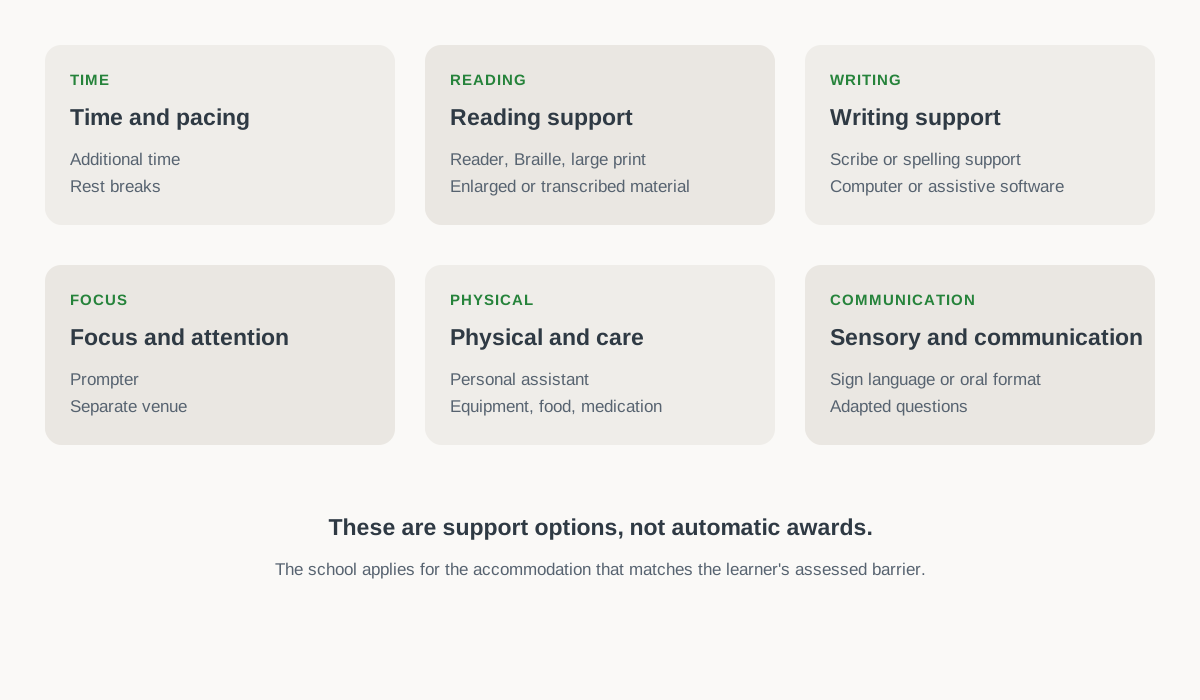
The DBE manual groups accommodation options by the barrier they are intended to address.
The accommodations South African parents ask about most
Additional time
This is the most frequently awarded accommodation, and for good reason. A child with a reading difficulty, a visual impairment, ADHD, chronic pain, or any condition that slows down processing or writing speed simply cannot finish a three-hour paper in three hours.
The manual sets out time allocations by category: 5–20 minutes extra per hour for physical disabilities and specific learning disorders, up to 30 minutes per hour for visual and hearing impairments. The extra time applies to all subjects. A barrier to learning does not switch off for Maths and switch back on for English.
If your child has been getting “extra time” informally from a helpful teacher, that is kind but it is not the same as a formally awarded accommodation. Only an approved application through the District-Based Accommodations Committee (DBAC) carries weight, particularly for Grade 12 where external examiners are involved.
A reader
A reader is a trained, accredited adult who reads the exam questions to your child, word for word, without explaining, rephrasing, or hinting. The learner still does all the thinking, all the answering, and tells the reader what to read next.
This accommodation is for learners with a diagnosed reading disorder (such as dyslexia), a significant gap between their chronological age and reading age (at least three years), or a visual impairment without Braille proficiency. The reader must not be your child’s subject teacher or a family member, and a separate venue is required. A reader can also be replaced with technology, a laptop with text-to-speech and earphones or an electronic exam paper on a USB, if introduced early enough in the child’s school career.
A scribe
A scribe writes down exactly what the learner says, verbatim, with the learner dictating punctuation, spelling where required, and layout. This is what the manual means by the handwriting accommodation. It is for learners with severe written-expression difficulties, illegible handwriting, physical disabilities that prevent writing, or visual impairments without Braille. For language papers, the learner must spell words themselves in Paper 1 (spelling is content knowledge) but dictates freely in Paper 3 (Creative Writing). Like a reader, a scribe needs a separate venue, extra time, and cannot be a subject teacher or relative. A laptop with speech-to-text software is an alternative if introduced early enough.
Spelling accommodation
A spelling accommodation means phonetic errors are not counted against the learner, as long as the word is decipherable. It is granted via a sticker on the answer script.
To get a spelling accommodation, the manual requires evidence of a diagnosed specific learning disorder with impairment in written expression, or a three-year gap between spelling age and chronological age. A psychoeducational assessment is the standard way to provide this evidence.
The DBE distinguishes between a language barrier and a learning disorder. A spelling accommodation is not granted if the primary difficulty is that the language of assessment is not the child’s home language.
Where a learner’s handwriting is too illegible to read, the accommodation is not a marker’s tolerance but the handwriting accommodation: a scribe who writes the answers for them, as described above.
A prompter
This is for learners who drift off during exams: children with ADHD, anxiety disorders, or autism who struggle with attention, focus, and organisation. The prompter gives short verbal cues like “focus on your work” or “take a deep breath,” or physical cues like a tap on the desk. They cannot help with answers. They cannot explain questions. They simply bring the learner back to the page.
The subject exemptions
Under the accommodation framework, the manual also covers two subject exemptions, both governed by Regulation 16 of the NSC and applying mainly in the FET phase:
- Language exemption: learners who are Deaf, have aphasia, or have a specific language disorder may be exempted from offering a First Additional Language. They replace it with another subject from Group B.
- Mathematics exemption: learners diagnosed with dyscalculia or a severe mathematical learning disorder may be exempted from Mathematics or Mathematical Literacy, replacing it with another approved subject. This application must be submitted when the learner enters Grade 10, or immediately after diagnosis.
Both exemptions go through the Provincial Director: Exams and Assessment, not just the district committee. The paperwork is heavier, and the bar is higher.
How the process works: from classroom to committee
This is the part that confuses parents most. The DBE system has layers, and each layer has an acronym:
Your child’s teacher identifies the barrier (or you do, and you raise it with the teacher). The teacher completes the SNA 1 and SNA 2 forms from the SIAS policy. These document what the difficulty is, what support has been tried, and what is being requested.
The School-Based Support Team (SBST) reviews the case. This is a group of teachers and staff at your child’s school. They look at teacher reports, work samples, school reports, and any psychological, medical, or therapeutic assessment reports you provide. They fill in Form DBE 124, which lists the specific accommodations requested, and Form DBE 120, which sends the application up to the district.
The District-Based Accommodations Committee (DBAC) decides. For Grades R–9, the DBAC has the final say. For Grades 10–12, the DBAC makes a recommendation and sends it to the Provincial-Based Accommodations Committee (PBAC) and the Provincial Director: Assessments and Examinations for final approval.
The decision comes back to the school, where it is captured on SA-SAMS and added to your child’s Individual Support Plan (ISP). From that point on, the accommodation applies to all school-based assessments and exams, not just one subject.
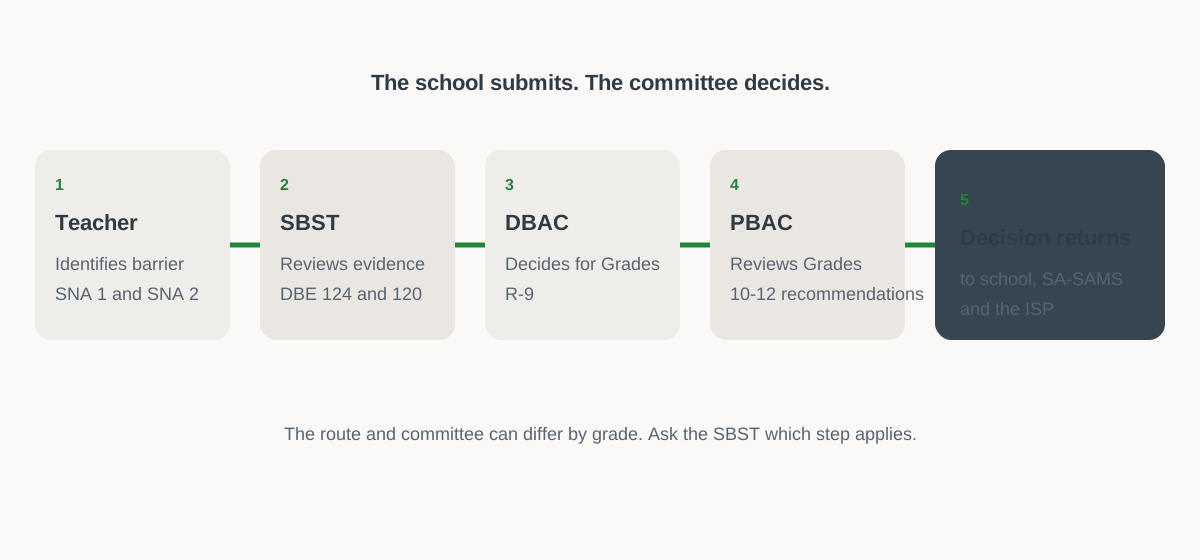
The school gathers and submits the evidence. The relevant committee makes the decision.
Where to find the official DBE documents
The Department of Basic Education’s Inclusive Education page links to the current SIAS documents, including the official SIAS policy. SIAS is the policy framework that places parents and teachers at the centre of identifying and supporting learners who experience barriers to learning.
DBE 120 and DBE 124 are forms used within the school and district application process. They are normally completed and supplied through the school or the relevant district office, rather than downloaded by parents from an unofficial copy online. Ask the SBST which current version applies to your child’s application, and keep a copy of anything you submit.
You may see older pages use the phrase concessions for learners with barriers. It is a useful search term, but the DBE’s current procedural language generally refers to accommodations and learners who experience barriers to assessment. The school or district can confirm the current form names and route for your child’s case.

The accommodation process starts with a conversation between you, the teacher, and the School-Based Support Team.
The manual says the whole process should take no more than three months from application to decision. In reality, it can take longer if documentation is incomplete or if the district has a backlog. This is why starting early matters.
What you as a parent can do right now
If any of this sounds like your child, here is where to start:
Talk to your child’s teacher. Ask directly: “Has an SNA 1 been completed? Has the SBST discussed this case?” Sometimes the school knows about the difficulty but hasn’t started the paperwork. A parent asking the question can be the nudge that gets it moving.
Get a psychoeducational assessment. This gives the SBST detailed evidence to consider alongside school records and teacher observations. As a registered Educational Psychologist (HPCSA Reg. No: PS 0158127), I assess the areas the DBAC looks at (reading age, spelling age, processing speed, written expression, attention) and produce a report the school can attach to the application.
Keep a paper trail. Save report cards, teacher comments, and samples of your child’s written work. The manual requires formal work samples (not drafts or mind maps) as supporting evidence. Three years of evidence is stronger than one term.
Don’t assume the school will handle everything. I have met parents who assumed the SBST was on top of things, only to discover in Grade 11 that no application had ever been submitted. Ask for updates. Ask to see the Form DBE 124. Ask what the DBAC decided.
If your child is in Grade 7, make the handover happen. The manual requires that accommodation records follow the learner from primary to secondary school. Ask the primary school SBST to send the file.
Frequently Asked Questions
Does the DBE still use the term “concession”?
No. The department previously distinguished between accommodations (how your child writes an exam) and concessions (what your child must offer for the NSC, such as being exempted from Mathematics or a second official language). Today the term “concession” has been dropped and the single word “accommodation” is used for all of them. You may still hear parents or older reports use the old term.
Does my child need a psychoeducational assessment to get DBE accommodations?
Yes. A registered psychologist’s or healthcare professional’s report is core supporting evidence for most applications. The school compiles this together with teacher observations, school reports, work samples, and SIAS documentation before submitting to the District-Based Accommodations Committee.
When should we apply for DBE accommodations?
For Grades R–9, applications are processed at district level through the DBAC and should be submitted as soon as the barrier is identified. The earlier the better. For Grades 10–12 (the FET band), the Provincial-Based Accommodations Committee must approve applications, and the process needs to be finalised preferably by the end of June of the Matric year. A psychoeducational assessment alone takes 2–3 weeks, so don’t wait until the last term.
Can my child’s school just give extra time informally?
A kind teacher may give your child a few extra minutes during a class test, but that carries no weight for formal assessments, progression decisions, or the NSC. Only an accommodation approved by the DBAC (or PBAC for Grades 10–12) is officially recognised. Without it, your child writes Matric under standard conditions, regardless of what happened in class.
If this sounds familiar
The DBE has put a formal system in place so that learners who experience barriers to learning can access support during exams. Knowing what is available is the first step toward getting your child that support under the law.
If you are wondering whether your child might qualify for DBE accommodations, a full psychoeducational assessment can provide the diagnostic evidence the committee needs. And if the barrier turns out to be a reading or spelling difficulty, dyslexia intervention can begin alongside the application. You don’t need to wait for a DBAC decision before starting support.
One last thing: this article covers DBE (public) schools. If your child attends an IEB school, the rules are different. I have written separately about IEB concessions and accommodations, the process, the deadlines, and what the IEB panel looks for.
You know your child better than any committee ever will. If your gut says something is getting in the way of their learning, trust that instinct. Get in touch. I am happy to talk through what you are seeing and whether an assessment makes sense.