
Adult dyslexia can sit behind a life that looks organised and successful. You may run a business, manage a team or hold a demanding professional role, yet still reread every email, avoid taking minutes, or ask someone else to check your spelling.
I regularly meet adults who have built clever ways around these difficulties. Many were never assessed because people assumed dyslexia belonged in the classroom. It does not end when school ends or set a limit on ability.
Dyslexia does not disappear after matric
Dyslexia is a developmental difficulty with accurate or fluent word reading and spelling. The pattern begins while reading skills are developing and can continue into adult life, even when practice and coping strategies make it less visible [1].
A person may read accurately enough for nobody else to notice, but need far longer to finish a report. Spelling may remain unpredictable. Verbal instructions, word finding or proofreading under pressure can also be hard for some adults [1]. None of these signs confirms dyslexia by itself.
A Finnish follow-up study assessed 48 adults with a documented childhood reading disability and 37 adults without that history. More than half of the childhood group no longer met the adult reading-fluency criterion, yet the group still showed weaker working memory, processing speed and verbal skills [2]. This small Finnish sample cannot predict one person’s future, but it shows how quieter difficulties may remain after reading improves.
Success and dyslexia can exist together
Being successful does not rule dyslexia out. Adults often choose roles that fit what they do well, prepare carefully and develop systems that colleagues never see.
Carol Leather and colleagues found that stronger planning and awareness of one’s own thinking were associated with greater job satisfaction and confidence among adults with dyslexia. Those skills were not linked to salary, promotion or qualifications in the same way [3]. A job title tells us little about the effort behind it.
Two systematic reviews by Joost de Beer and colleagues found that reading and writing demands, feelings about dyslexia, colleagues’ attitudes and working conditions all mattered. Helpful factors included coping strategies, assistive technology and workplace adjustments [4,5].
Dyslexia is neither a mark of low ability nor a special talent that guarantees creativity or business success. Each adult has a different mix of strengths, difficulties and support.
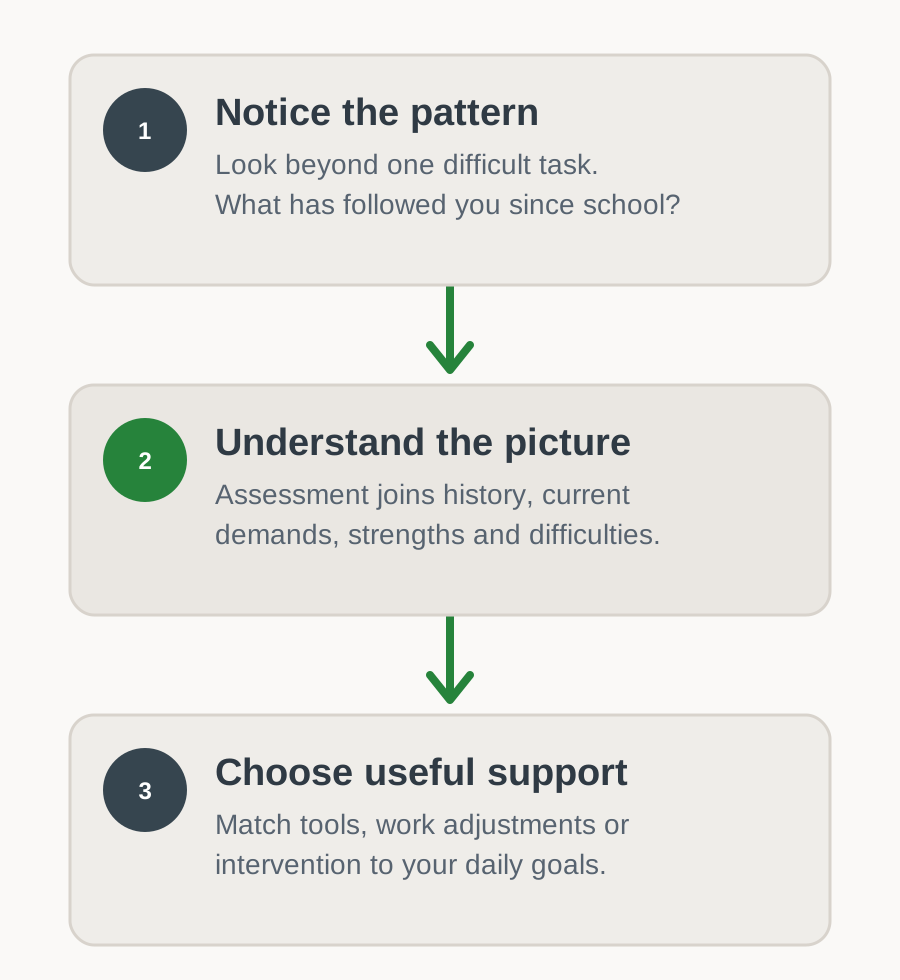
Adult dyslexia support starts with the pattern you experience, then matches assessment and practical help to your daily demands.
Signs an adult may recognise
You may want to ask more questions if several of these have followed you from school into adult life:
- Reading is accurate but slow and tiring, especially with dense documents.
- You reread emails several times before their meaning settles.
- Spelling remains inconsistent, including familiar words or names.
- You avoid reading aloud, filling in forms in front of someone, or writing on a shared screen.
- Spoken explanations make more sense than long written instructions.
- Voice notes, templates, spellcheck or another person’s proofreading have become essential workarounds.
- A child or close relative has been identified with dyslexia, and their experience feels familiar.
These examples are starting points, not a checklist that diagnoses you. Attention, language background, education, vision, hearing, stress and other factors can affect the same tasks.
What an adult assessment can clarify
An adult assessment should begin with the question you need answered. Perhaps university reading has become hard to manage, reports take hours, or your child’s assessment has made you rethink your school years.
As a registered Educational Psychologist (HPCSA Reg. No: PS 0158127), I look at the history behind the present difficulty and current demands. A psychoeducational assessment may consider school history, reading, spelling, language skills, memory and processing speed. Test selection must fit the adult, language background and purpose.
There is no single test that settles every case. A 2022 systematic review found wide variation in how psychologists identify dyslexia and called for clearer shared assessment guidelines, especially for adults and countries outside the United States [6]. A careful conclusion therefore comes from the whole pattern, not one score.
A health safeguard
Dyslexia is developmental, so the history usually reaches back to school. If reading, language or writing ability has changed suddenly, or the change is new in adulthood, speak to a GP or other appropriate medical professional rather than assuming it is dyslexia. Vision and hearing concerns should also be checked when they could be affecting daily tasks.
Where the Davis Method may fit
The Davis Method uses practical work around attention, orientation and symbols. In my practice, I have seen adults find parts of it useful after years of forcing themselves through print. The work is adapted to the person’s goals. You can read more in my Davis Method guide for families and on the dyslexia intervention programmes page.
That practice experience needs an honest research note. The published Davis evidence is limited and does not include a strong adult-specific trial. A 2003 Italian comparison included a Davis-inspired group of 16 school-age learners. Reading speed improved, but average errors remained above the study’s sufficiency threshold. The authors also noted that a later group of 10 did not show statistically or clinically significant change [7]. The study was small, was not randomised, involved Italian children rather than South African adults, and tested a Davis-inspired programme rather than every current form of Davis work.
For those reasons, I do not present Davis work as a cure or a guaranteed answer. It may be one option to consider after understanding the adult’s profile, alongside assistive tools, direct literacy support, changes to work routines and other assessment-led recommendations.
Practical support can start now
You do not need to wait for a label before making daily tasks easier.
- Use text-to-speech for long reports and speech-to-text for a first draft.
- Ask for important instructions in writing, then talk them through if that helps.
- Build proofreading time into deadlines instead of doing it under pressure.
- Use templates, checklists and calendar reminders for repeated tasks.
- Keep examples of the work that is difficult and the strategies that help. They make an assessment or workplace conversation more concrete.
The goal is to reduce unnecessary effort and find a reliable way to do the work that matters.
Frequently Asked Questions
Can a successful adult still have dyslexia?
Yes. Dyslexia can affect reading, spelling or written work without limiting intelligence, judgement or career ability. Many adults build strong coping strategies, choose work that suits their strengths and become highly successful without recognising the reason certain tasks still take extra effort.
What are common signs of dyslexia in adults?
An adult may read accurately but slowly, reread emails several times, struggle with spelling or written instructions, avoid reading aloud, or rely heavily on voice notes and other workarounds. These signs can have several causes, so a pattern across school history and adult life matters more than one difficulty on its own.
Can an adult be assessed for dyslexia in South Africa?
Yes. An adult assessment considers early school history, current reading and writing demands, coping strategies, and standardised measures chosen for the referral question. The aim is to understand the whole pattern and make practical recommendations, not simply attach a label.
Can the Davis Method help adults with dyslexia?
Some adults find the Davis Method’s practical work with attention, orientation and symbols useful. Adult-specific research is limited, so it should not be presented as a guaranteed solution; the right support depends on the person’s assessment, goals and response to the approach.
A gentle next step
If you have managed for years, asking about dyslexia now may give a name to the effort you have been carrying and help you choose better tools for what comes next.
You can send me a message with the difficulty you are noticing and what you would like to make easier. We can discuss whether an adult assessment, Davis work or another route makes sense. There is no obligation to book.